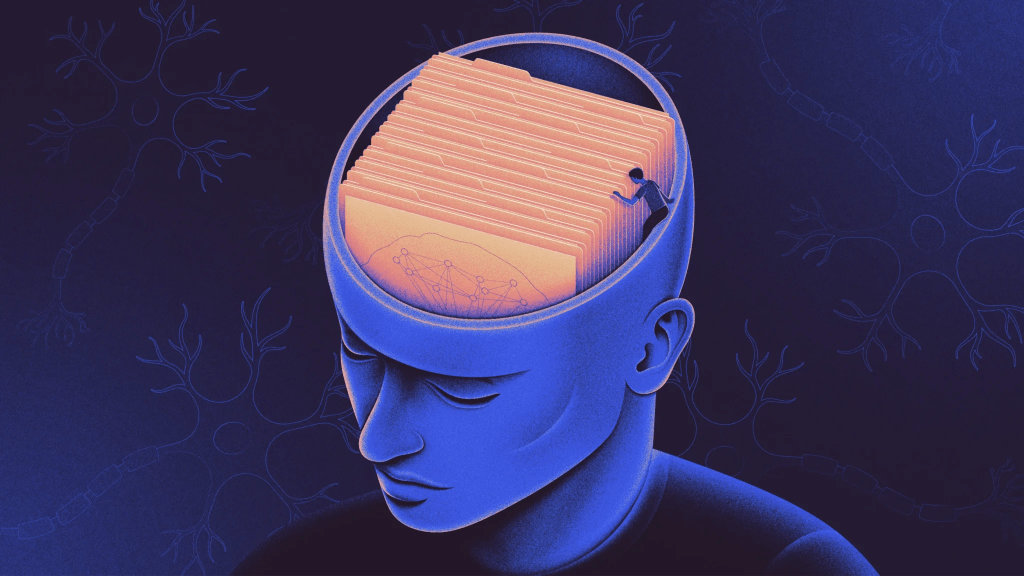
In a world where knowledge is readily available in books and online, where terms can be looked up and languages can be translated automatically, one might wonder what other purposes are left for committing facts to memory.
Lately, I have been thinking a lot about that particular question. From my point of view, memory offers unique benefits, even in this world of printed texts, online encyclopedias, and translation apps. These benefits make memorizing a worthwhile endeavor, even if people grow increasingly impatient with it.
———————————–
1. The Speed Advantage
The main benefit of keeping knowledge in your memory is speed. Once an idea is fully processed by your mind—when it is connected with every other bit of information, life experience, and memory inside your brain—that idea is firmly lodged there and can be recalled at a moment’s notice. The speed of that recall can be instantaneous. It allows you to make split-second decisions and react in a flash to whatever situations the world around you presents. While looking up information externally from a book, computer, or phone can also be fast, it simply cannot compare to recalling information internally from your own memory.
Speed is crucial not only in high-pressure environments, such as emergency situations or professional fields requiring quick decision-making, but also in everyday life. Whether you are engaging in a conversation, making an argument, or solving a problem on the spot, having immediate access to memorized knowledge provides confidence and fluidity that cannot be matched by reliance on external resources.
———————————–
2. The Power of Pattern Recognition
Another important benefit of memorized knowledge is that it provides the input for the pattern-recognition machine in your brain. The mind needs to access all relevant data at once to see the connections between seemingly separate concepts, people, things, and events. Externalized information is often stored across a multitude of different media—especially data from different sources—making the collection and accessing of such data a chore.
This fragmentation can easily overwhelm and fatigue the brain, leaving little energy for the demanding task of pattern recognition.
Internalized information, on the other hand, can be seen all at once, immediately, and manipulated in whatever way the thinker needs. One can isolate certain bits of data and put them side by side, combine various elements into a larger whole, and evolve any memory to engage in creativity. This ability to freely process and recombine information enhances critical thinking, problem-solving, and creative pursuits.
When coupled with superior speed, memorized information becomes the best input material for the brain to produce high-quality outputs such as decisions, conclusions, attitudes, and even innovations.
———————————–
3. The Cost of Memorization
However, memorized knowledge also has its costs. The primary cost is time—time to find and access the needed information, time to evaluate its accuracy, time to fully integrate it into one’s mental framework, and even—if necessary—time to purge the brain of wrong or unneeded information that has already been internalized. This last task, in particular, is one of the hardest, as outdated or incorrect knowledge can be deeply ingrained.
Interestingly, I have noticed that the time it takes to process this raw material (information harvested from books, the internet, and the outside world in general) is often positively proportional to the quality of the refined material (memorized information that can be stored indefinitely in one’s brain and serve as high-quality input for the brain’s calculations). In short, the longer it takes, the longer it lasts—if it is hard to remember, it is also going to be hard to forget, as the saying goes.
I would like to add to that line of thought: the longer it lasts, the longer it changes you. If it is hard to forget, it is going to shape you and impact your life for as long as it is remembered. This is perhaps the most profound aspect of memory—its ability to shape identity. What we choose to remember, and how we remember it, forms the core of who we are, influencing our values, decisions, and aspirations.
———————————–
4. Memory in the Digital Age
In the digital age, we often outsource our memory to devices. We do this to free up mental space for other tasks and save precious time—an increasingly valuable asset in this busy world. But at what cost? Reliance on external tools can make us less self-reliant, less adept at connecting disparate pieces of information, and more susceptible to information overload.
We may reach a point where we outsource not only the storage of the knowledge we need but also the process of such knowledge. Some external source—be it another person or an AI—may think for us, connect the dots for us, and draw conclusions for us. Our role may be reduced to that of obedient sheep, following directions with no argument. Such trust is tantamount to giving up our own free will and autonomy.
———————————–
5. Memory as a Form of Connection
So far, I have stressed the points of using memory to better serve practical needs, but memory is more than just a tool; it is also a form of connection. The English language has only one word for the two concepts that my mother tongue—Vietnamese—wisely distinguishes. In English, “memory” refers both to information stored in the mind (what we call ký ức) and to the life experiences shared with others, especially our loved ones (what we call kỷ niệm).
Kỷ niệm is sentimental, and I am not what I would consider a sentimental person, yet I would be a fool to underestimate the importance of personal and collective memories. Such memories—the latter type—can be shared laterally, resonating with people in your community. They can also be shared vertically, passed down through stories for posterity. Just as personal memories define the identity of an individual, shared memories bind communities, families, and cultures. Memorizing a song, a prayer, or a tradition links us to others who have done the same, creating a shared sense of identity and belonging. In this way, memory serves as both a personal and a collective treasure, preserving not just facts but the essence of who we are.
———————————–
Conclusion
In an era where external aids are abundant, it is easy to fall into the trap of relying solely on technology to store our knowledge. However, memory remains an irreplaceable facet of our human experience. It empowers us with speed, enriches our ability to recognize patterns and make connections, and ultimately shapes our identity. Beyond its practical uses, memory serves as a bridge between our past and our future, between individuals and their communities.
While technology continues to evolve, we must strive to maintain a balance—leveraging external tools without losing our internal capacities. By consciously cultivating our memory, we safeguard our autonomy, deepen our understanding of the world, and forge meaningful connections with those around us. After all, what we remember not only defines what we know but also who we are.
———————————–
Đà Nẵng, ngày 26.1.2025
Nguyễn Tiến Đạt (sutucon)

 Tập Viết
Leave a comment